

We are all familiar with the common statement that “your house is a good investment and rent is pouring money away.” However, we will demonstrate in this article how this is often not true. For many people renting may be the better financial decision where as purchasing a home as a primary residence is often more of a lifestyle decision rather than a financially savvy move. Note that this article focuses on real estate as a primary residence and not as an investment property strategy for example: (1) rent for cash flows (in addition to holding for potential appreciation), (2) buy an undervalued property, renovating it and selling for a quick profit, so called “fix-and-flip”, or (3) house hacking a multi-unit property. All of these examples represent completely different financial scenarios and often can be very good investment strategies in the right hands. There are plenty of good resources on these topics (e.g. BiggerPockets) and we encourage everyone interested in real estate investing to check them out.
Although owning a home as a primary residence can build equity and potentially appreciate in value, this is not guaranteed and often the hidden costs and risks related to homeownership can substantially reduce the return on investment (“ROI”). These include, but are not limited to, buying and selling costs, financing costs (i.e. your mortgage), insurance, property taxes, HOA fees, as well as maintenance and repair costs since after all we are dealing with a deteriorating asset. Not to mention any optional renovations that people pay for, in many cases also managed by expensive general contractors. Further, many of the tax benefits related to owning primary residence are often exaggerated and not feasible in many situations given the current high standard deduction amount (for the 2025 tax year,$31,500.00 for a married couple filing jointly). Lastly, the value of the property is often tied to the fortunes of one neighborhood! The bottom line, a home will cost much more money beyond the initial purchase price and those costs will add up to the point where in many instances most of the gains from the appreciation of the property value will be wiped out.
Let’s look at this through two examples: one from a typical high cost of living area (“HCOL”) and another from a medium cost of living area (“MCOL”), which demonstrate the numbers behind the math of renting vs. buying. We are using 20% down payment and fixed 30 year mortgage with 6.426% interest rate for these examples.
HCOL example
- Avg. home purchase price: $1,400,000
- Avg. rent (monthly): $3,000
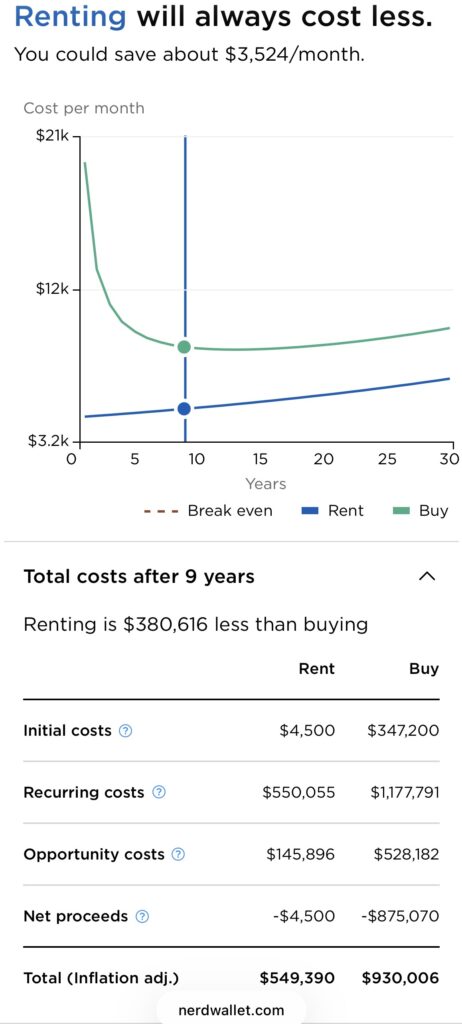
When running through a rent vs buy calculation in a high/very high cost of living area (we used NerdWallet’s Rent & Buy calculator but there are other free ones available online), the end result was that financially it would ALWAYS cost less to rent than buy. This is the situation where we found ourselves in and decided to sell our home and rent for as long as we live in this particular area. For us the opportunity cost of having so much of our wealth tied to an illiquid asset was not worth it when it could be generating us returns in the market. Let’s compare this to a typical medium cost of living area.
MCOL example
- Average home purchase price: $600,000
- Average rent (monthly): $3,000
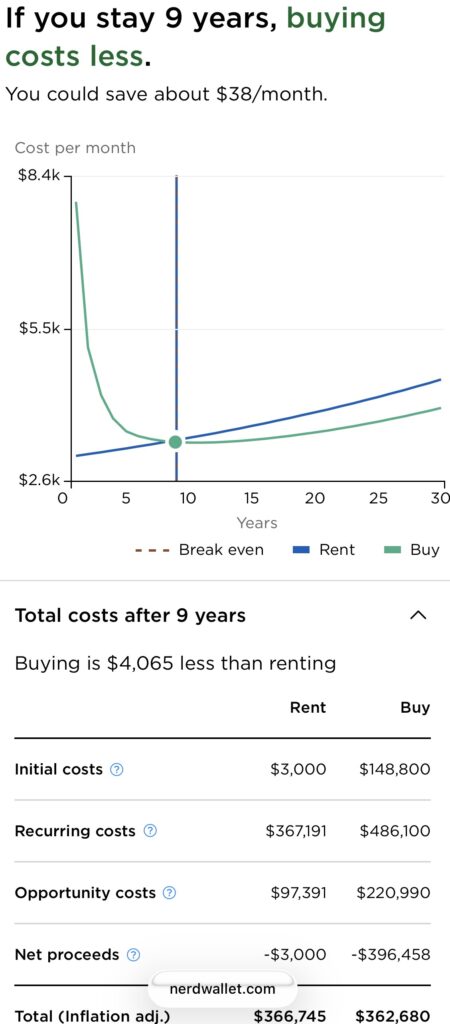
Here we see how the math starts leaning slowly in favor of buying but not until 8-9 years of ownership. There are other quick ways to assess if buying is financially smarter than renting for example the Rule of 150 which quickly gauges if the added costs of homeownership make it more expensive than renting. How this works is that you multiple your estimated monthly mortgage payment (principal, interest, property taxes, insurance) by 150% and if your number is higher than the estimated rent of an equivalent house, then renting is likely cheaper than buying. On the flip side, if it is lower, then buying might make more sense financially.
Lastly, there is a psychological aspect to all of this. In our North American culture, we are often “expected” to get a good job, get married and buy a home but why? To keep up with the Joneses? As a status symbol? As a badge for achieving the American dream? Mrs. FISU and I had a hard look at our why and we realized that our idea of “home” is not tied to a permanent house that we own rather it is where we are physically together as a family. Further, owning a home would limit our flexibility to travel and explore the world, which is one of our family priorities. Also, when our kids come home from school, they don’t care whether we own the house we live in or not, it is their home because we live there together.
The key takeaway here is that even though a typical middle class family keeps majority of their net worth in their primary residence, buying a house is not always a slamdunk financial move and there are many instances where people would be better off financially to rent. In many instances buying a home may prevent you from accumulating the wealth needed to retire early. We are obviously not saying that homeownership should not be considered if you want to pursue Financial Independence (“FI”) but rather that it is advisable to do the math and truly reflect on why you need to own a house before making such significant decision. Further, it is crucial to understand the potential implications of a house purchase since housing and vehicle costs are typically the two most significant expense categories impacting your savings rate and thus your ability to reach FI.
If you think homeownership is important to you from a lifestyle perspective and renting is not an option then it would still be advisable to consider buying a house that you can easily afford and that fits your lifestyle as this is often a better decision from a FI perspective than going all out on the largest and fanciest house that you can afford on paper.
Key takeaways:
- Houses are often lifestyle indulgences, not investments
- If you are looking for a new home, do the math behind buying vs. renting (including utilizing an online calculator) and also determine your why before making such a significant financial decision
- If you are currently a homeowner, it may still make sense to do the calculations and you may find yourself in the same boat as Mrs. FISU and I who transitioned from homeowners to renters
- If you are adamant on buying a house, it would be advisable to buy one that you can easily afford and that fits your lifestyle rather than the largest and fanciest house that you can afford per your mortgage calculations
- To bring it back to FI, the housing and vehicle expenses are often the largest obstacles between you and your FI number
– Mr. & Mrs. FISU